METEOR75 PRO II / LEELA35-second excerpt · Silent replay
Watch Leela find the calibration board and acquire its lock. The overlay uses the flight’s recorded tracking state, board center and sensor readings; camera interference remains visible.
About this recording
This is a real hardware flight recorded on November 5, 2026, at 1:47 p.m. EST. The excerpt runs from flight +8 to +43 seconds. Leela is enabled at +9 seconds and first records a lock at +10.046 seconds, with approach and short gap states retained in the replay.
The brackets mark the logged board center; the cyan cross marks the aim point. Distance comes from the saved 0.50 m camera reference and is approximate. Height is the sensor estimate above the launch datum. Video and telemetry share host receipt timing; the overlay does not measure camera or radio latency.
The complete 50-second flight later ends in guided landing and automatic disarm. This excerpt shows acquisition and tracking.
Inside Planet Express
Your flight workspace.
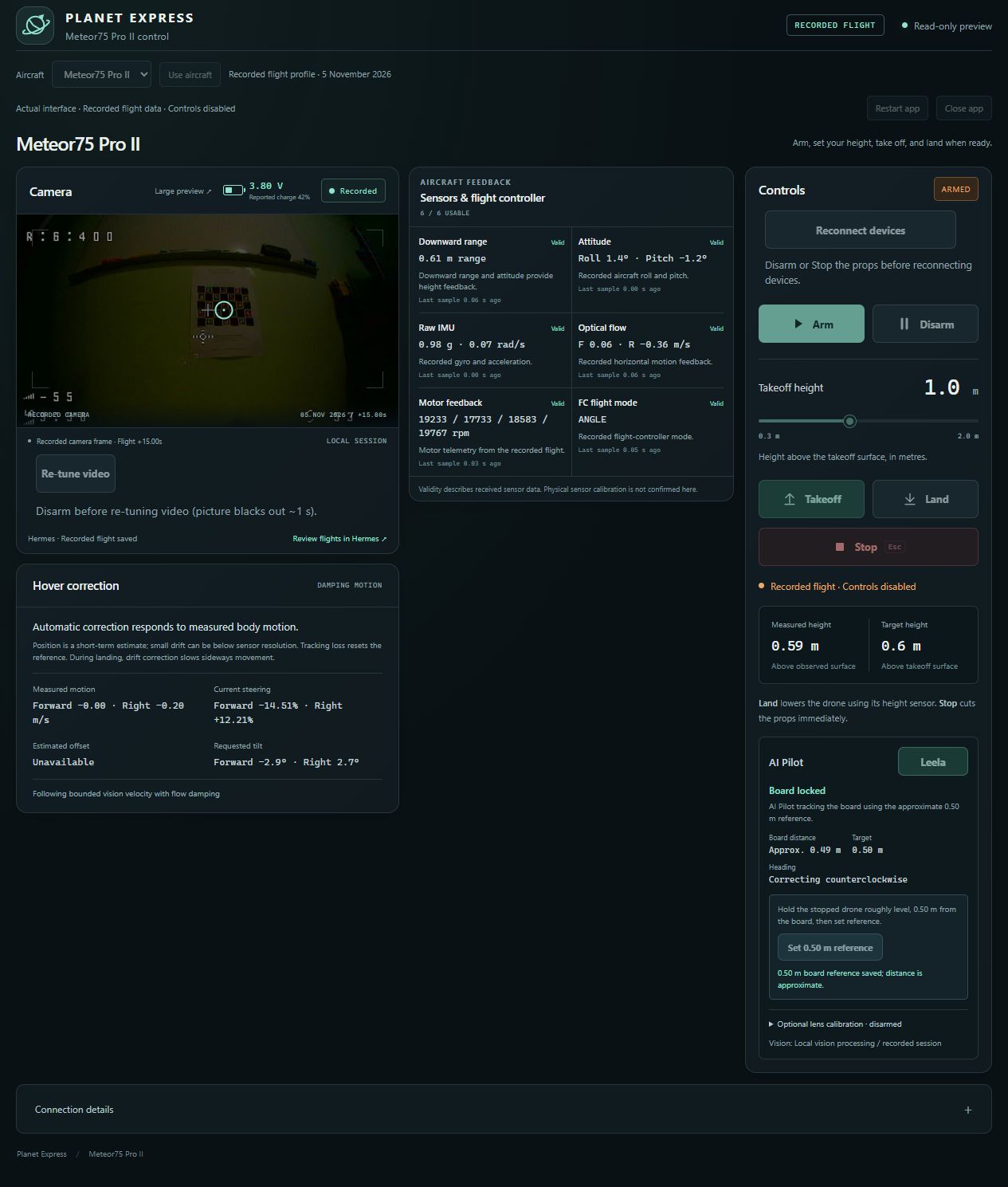
The camera, flight controls, sensor feedback and Leela’s board lock, together in the app.
The actual ground-station interface, shown with recorded flight data.
PlatformLocal Windows ground station
Aircraft profilesAir75 / Meteor75 Pro II
Flight reviewRecorded video + telemetry
One flight. More evidence.
From camera view to the next adjustment.
Planet Express connects flight controls, visual guidance and recorded evidence through a repeatable testing loop.
01 / Ground station
Keep the flight in view.
Live FPV video sits alongside aircraft telemetry and Arm, Takeoff, Land and Stop controls. Range and optical-flow feedback support climb, hover and descent, with separate aircraft profiles.
Video / Controls / Telemetry
02 / Leela
Give hover a visual reference.
Opt-in vision recognizes a ChArUco calibration board and requests bounded centering, distance and heading corrections. Sensor hover continues while Leela searches or visual evidence expires.
Board acquisition / Visual hold
03 / Hermes
Replay what actually happened.
Video and control logs are saved together from Arm to Disarm. Replay the camera view against height, steering and tracking state, then use the evidence to guide the next adjustment.
Recorded video / Synchronized logs
Developed in the air
Fly. Review. Adjust. Fly again.
The project is developed through real flight sessions: fly the aircraft, review the saved video and telemetry, make a targeted change while disarmed, and compare the next flight.
The replay comes from the November 5 soft-centering build on a Meteor75 Pro II. It shows board acquisition and tracking from that hardware session. Camera dropouts, approximate reference distance and ongoing flight tuning remain part of the work.
Hardware-tested software / Experimental project in active development
 RHO-BOTIC